

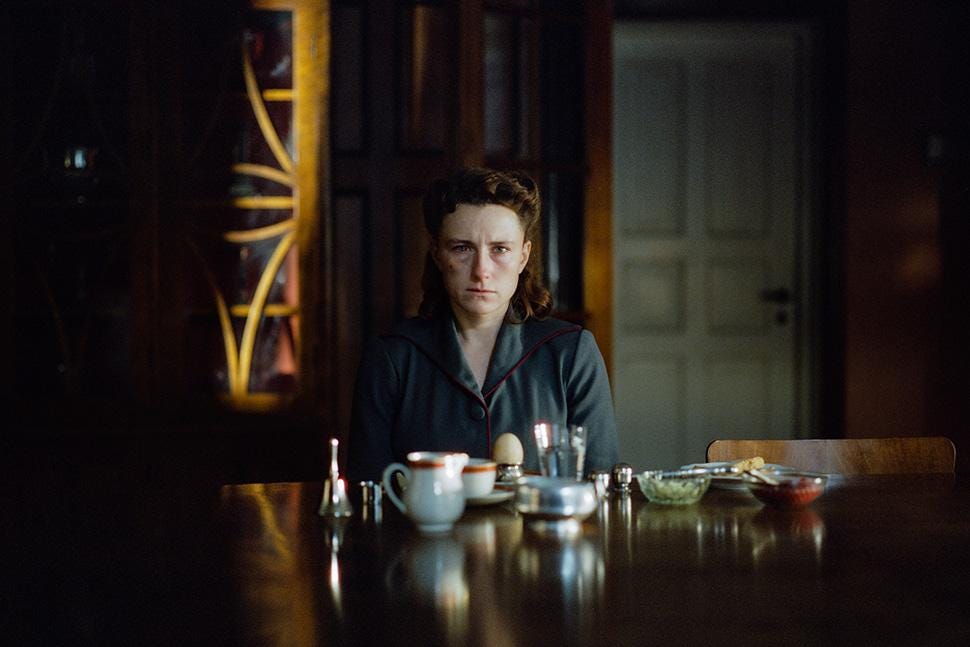
May el-Toukhy directs Woman Unknown, starring Mathilde Arcel, screening at the 2026 BFI London Film Festival. A compelling and quiet evisceration of post-war Danish society, exquisitely shot, that will stay with me for a long time.
Plot in a nutshell
In the aftermath of World War II, housemaid Marie (Arcel) is preparing to marry her wealthy employer, Christian (Carsten Bjørnlund), hoping to start a new chapter in post-war Denmark. But when the past she has tried so hard to bury threatens to resurface, she finds herself fighting for her reputation and the future she’s desperate to secure.
The Review
How far will you go to protect yourself? The simple question that hangs in the air of this elegantly composed Danish period drama, and nips at the tension of some of the film’s many long silences. The formality of the compositions, the tidiness of the mise-en-scene, the meditative calmness that demands patience from the audience; this sophisticated and polished surface masks something undeniably rotten at the core of the society on display. Patience is rewarded with Woman Unknown as it builds up gradually towards a quietly devastating conclusion, revealing an extraordinarily mature and cinematically rich film.
It won the top prize at the Venice Film Festival and Mathilde Arcel picked up Best Actress, which immediately put this otherwise unknown entity on my radar. And now I’ll be following the careers of director el-Toukhy, lead actress Arcel, and cinematographer Jasper Spanning with a keen eye. The direction is fluid, with the immediate aftermath of the Second World War, and the atmosphere of guilt and shame and wanting to “set things right”, captured perfectly in a show-don’t’-tell masterclass of composure. One particular scene towards the end, a single shot of a nameless woman, will haunt me for quite some time.
Arcel’s performance is an internal storm, a tempest brewing with guilt and survival instinct; she conveys so much with only her eyes. The cinematography is also some of the best of the year, with some of the shots and framing involving mirrors, reflections, and figures distorted behind textured glass, so striking that they wouldn’t feel out of place in a Johannes Vermeer exhibition.
The most potent aspect of Woman Unknown, though, is the story itself. Told very much from the perspective of the female gaze, and yet dealing with the universal, gender-less, theme of retribution, shame, guilt and survival. Once Marie finds herself in the critical predicament, the second half is filled with so much tension and a multitude of powerful thematic undercurrents. It is truly exceptional storytelling, with one wallop of a twist that’s impossible to see coming.