

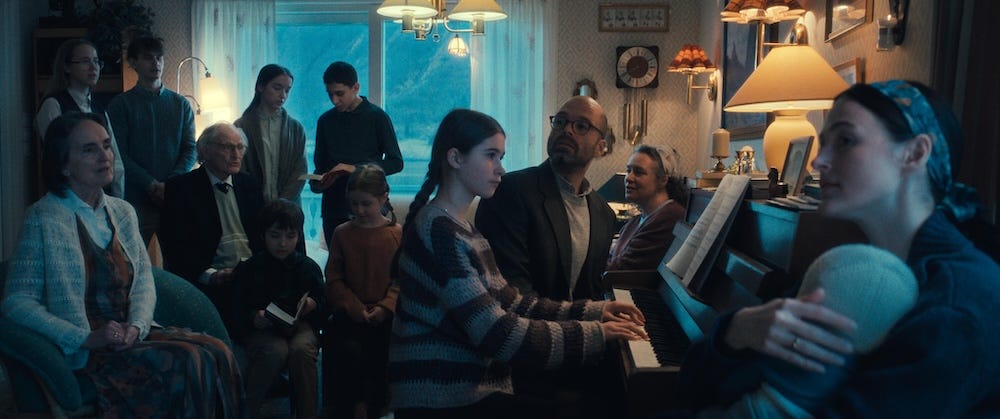
Cristian Mungiu returns triumphant with Fjord, starring Sebastian Stan and Renate Reinsve, as screened at the 2026 BFI London Film Festival. It’s another controversial Palme d’Or winner, and I have nothing but deep reverence for it.
Plot in a nutshell
When deeply religious couple Mihai (Stan) and Lisbet (Reinsve) move to a remote Norwegian fjord with their five children, their conservative values begin to stand out in their more progressive and liberal community. After a few school teachers notice bruises on the teenage daughter's body, things quickly escalate and Child Protection Services get involved.
The Review
Romanian master of brooding cinema is back with his most controversial film to date. Putting a deeply religious, conservative family at the centre of attention, and asking the audience to decide whether they are heroes or anti-heroes, offenders or victims, is a pretty courageous thing to do in this day and age. In film culture, certainly in Western film culture, progressive and liberal values are self-evident moral truths. Conservatism, traditionalism - almost always depicted in a religious framework, and most especially a Christian one - are at best inherently suspect and at worst straight up evil.
What makes Fjord such a fascinating viewing experience is how Mungiu inverses this axiom and presents two sides of an argument where he dares the audience to see things from the point of view of the conservative, deeply Christian, traditional family. They’re not evil people, caricatures or stereotypes. The fact that they’re portrayed by two serious, famous actors - Sebastian Stan of Captain America fame and the ineffable Renate Reinsve whose star has shot up more than most in recent years - only adds to the inversion. Both performances are exceptional, nuanced and natural; the direct opposite of Hollywood showboating.
The sun continues not to shine in Mungiu’s cinema, but that’s not to say that there isn’t beauty in this world. There are more than a few wide landscape shots of cosmic power, with Norway’s wintery beauty of the fjords, its icy waters and frequent avalanches, adding a remarkable presence of ominous dread to the atmosphere that locks the viewer in even further. The camera, with some imperceptibly long takes, alongside exceptional blocking for interior compositions, also does wonders to paint a compelling world of human pieces on life’s chessboard.
Watching the incident spiral, escalate and finally conclude makes for one of the most edge-of-your-seat experiences I’ve had in the cinema all year. Adding to the layers of this complex fable about parenting, ethics, freedoms, values and beliefs, are two subplots: a friendship between the teenager daughter Elia (Vanessa Ceban) and her neighbor and schoolmate Noora (Henrikke Lund-Olsen), and another around Noora’s aging grandfather who suffered a stroke, Åke (Øyvind Venstad Kjeksrud). These appear as tangents at first, but are relevant on a cerebral level, adding a few extra dimensions.
Thought we get to see the film from the POV of the family, Mungiu sprinkles enough intrigue around what happens off-screen to make the audience really ponder the film as an ethical thought experiment with two equally strong sides on either end of the debate. By and large, it is one of the most impressive films of the year, and the fact that it’s a Palme d’Or winner gives it an air of prestige and importance that it absolutely deserves.